A plain-English look at the May 2026 data — and what it means if you're buying, selling, or relocating to Kelowna, West Kelowna, Vernon, Penticton, or the South Okanagan.
If you’ve been watching the economic news out of Ottawa and wondering whether this is a good time to make a move in the Okanagan, here’s the honest answer: the national picture is uncertain, but the local picture is more interesting than the headlines. Canada’s economy shrank late in 2025 and basically treaded water through the first quarter of 2026, according to Statistics Canada. The Bank of Canada held its rate at 2.25% in April, forecasting modest growth of 1.2% for 2026. BCREA expects BC home sales to dip 2.1% this year, then bounce back 7.7% in 2027. None of that is a collapse. It’s a market finding its footing. What I’m seeing on the ground: buyers are careful but very much out there. Sellers who price to today’s market are still selling. And the Okanagan — which is really three different markets wearing one name — still offers some of the best value in BC for people who want a better life without blowing up their budget.
Source: Association of Interior REALTORS®
Source: CREA MLS® HPI / Association of Interior REALTORS®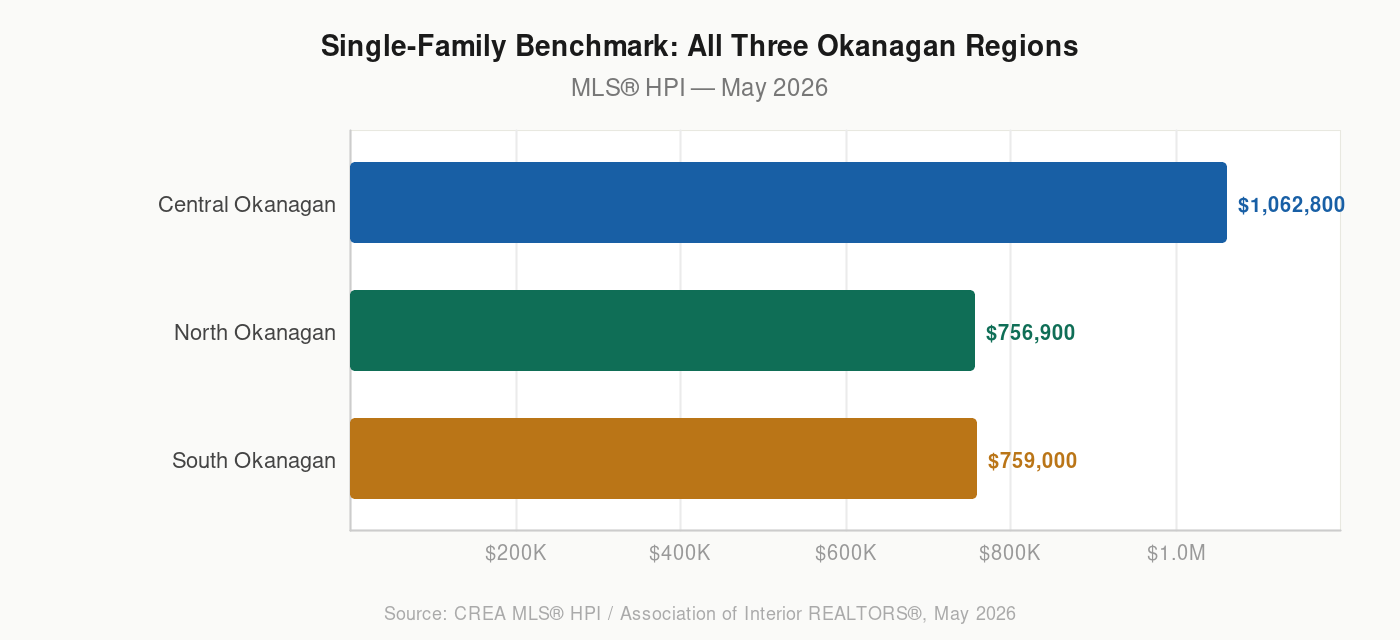 Single-family benchmark prices are basically flat year over year. Sales dipped from last May — but last May was busy. Inventory is up, which means you can look around and think before writing an offer. Well-priced homes in established neighbourhoods — Smith Creek, Shannon Lake, Lakeview Heights, Glenrosa, Kelowna North, Pandosy — are still selling within reasonable timeframes. Best fit for: buyers who want walkability, a bigger-city feel, and a short drive to the airport — and don’t mind paying for it.
Source: Association of Interior REALTORS®
Source: CREA MLS® HPI / Association of Interior REALTORS®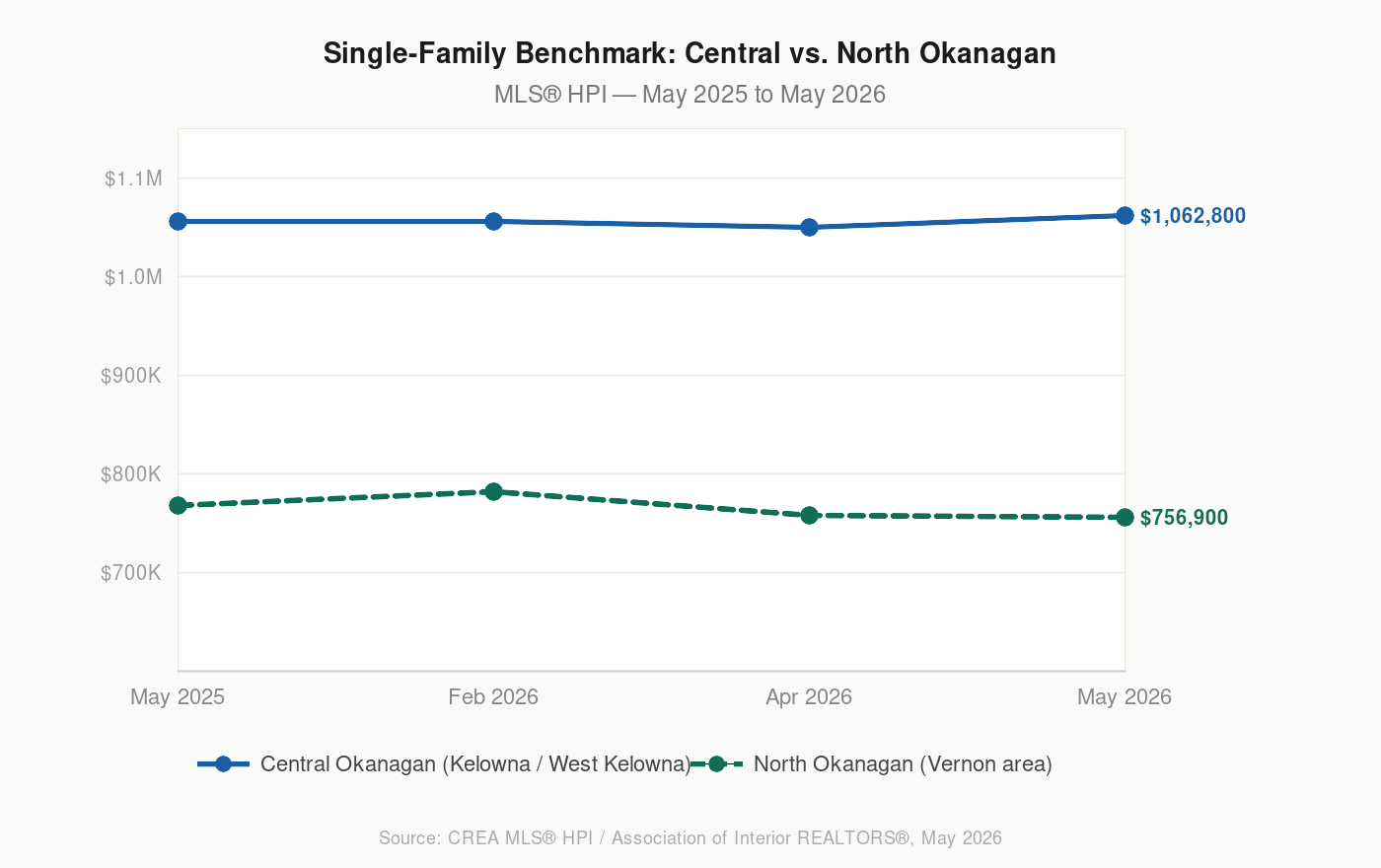 Vernon’s single-family benchmark is roughly $306,000 less than Kelowna’s, with the same kind of lake access and trail systems. Prices softened 1.4% year over year, which gives buyers real room to negotiate. Add Silver Star Mountain, Kalamalka Lake, Armstrong farmland, and Coldstream’s tight-knit feel, and you get a region that works for families, retirees, and remote workers who want space without isolation. Best fit for: buyers who want more home for the money, a quieter pace, and full access to the outdoors.
Source: Association of Interior REALTORS®
Source: CREA MLS® HPI / Association of Interior REALTORS®
Source: CREA MLS® HPI / Association of Interior REALTORS®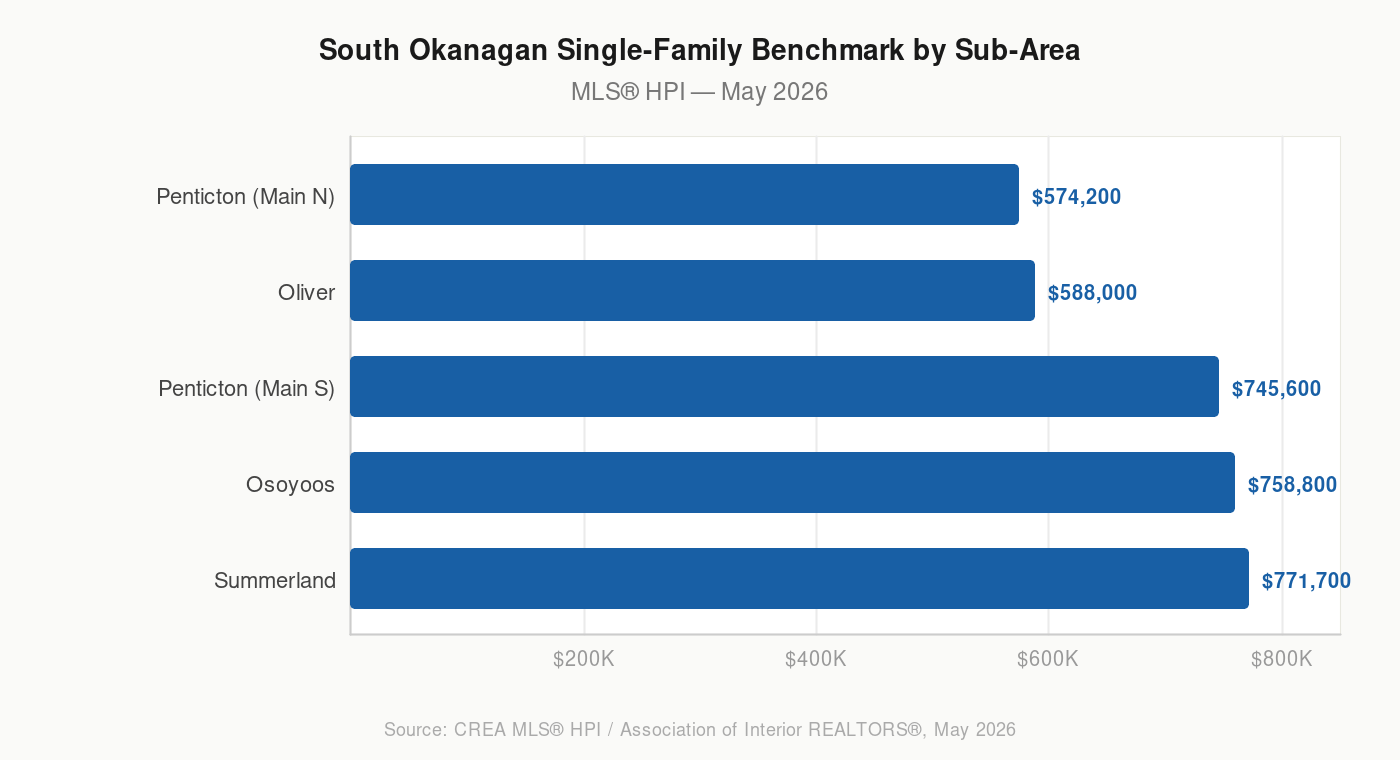
 The South Okanagan posted the strongest sales growth in the valley in May — up 26.6% year over year — while single-family prices eased 3.4%. Translation: buyers are showing up and finding value. If your timeline is flexible and lifestyle is the priority, this is some of the most approachable buying in the valley, with some of the best living. Best fit for: buyers who want wine country, a relaxed pace, or a lower entry point into Okanagan real estate.
No. Sales are down modestly from peak activity in some regions, but MLS® HPI benchmark prices are holding near flat in the Central Okanagan and softening only modestly in the North and South. BCREA forecasts a rebound in BC sales in 2027. A slower market is not a crashing market.
Is now a good time to relocate to the Okanagan?
For financially ready buyers with a longer-term plan, it can be a good time. Inventory is up, benchmark prices in the North and South Okanagan are below where they were a year ago, and sellers are more willing to negotiate than at the peak.
What's the difference between Kelowna, Vernon, and Penticton right now?
Kelowna is the most active and most expensive — single-family benchmark at $1,062,800. Vernon gives you significantly more home for your money at $756,900. Penticton and the South Okanagan have benchmarks ranging from $574,200 in Penticton Main North to $771,700 in Summerland.
How long does it take to sell a home in the Okanagan right now?
In May 2026, single-family homes averaged 50 days to sell in the Central Okanagan, 51 in the North, and 59 in the South. Well-priced homes move faster; overpriced ones sit. Pricing to today’s market matters more than the average — in West Kelowna and everywhere else in the valley.
Should I sell before I buy in this market?
It depends on your equity, your timeline, and your tolerance for carrying two properties. In the current market, there's a reasonable case for selling first so your budget is clear. There's no universal answer — it comes down to your specific numbers and situation.
If you’ve been watching the economic news out of Ottawa and wondering whether this is a good time to make a move in the Okanagan, here’s the honest answer: the national picture is uncertain, but the local picture is more interesting than the headlines. Canada’s economy shrank late in 2025 and basically treaded water through the first quarter of 2026, according to Statistics Canada. The Bank of Canada held its rate at 2.25% in April, forecasting modest growth of 1.2% for 2026. BCREA expects BC home sales to dip 2.1% this year, then bounce back 7.7% in 2027. None of that is a collapse. It’s a market finding its footing. What I’m seeing on the ground: buyers are careful but very much out there. Sellers who price to today’s market are still selling. And the Okanagan — which is really three different markets wearing one name — still offers some of the best value in BC for people who want a better life without blowing up their budget.
Why This Matters If You're Relocating to the Okanagan
People moving here from Vancouver, Calgary, or Ontario aren’t chasing a quick flip. They want the life: lakes, trails, wineries, mountains, four actual seasons, and a commute that doesn’t eat their evenings. That demand doesn’t vanish when GDP slows. A softer market usually works in a relocation buyer’s favour — more inventory to compare, sellers willing to negotiate, and prices in parts of the valley sitting below last year. The trick is knowing which part of the Okanagan fits your situation. Kelowna, Vernon, and Penticton are three very different markets right now.Central Okanagan — Kelowna and West Kelowna
Kelowna is the busiest market in the valley. Most amenities, most jobs, most walkable neighbourhoods, most buyer interest. Also the biggest price tags. May 2026 Market SnapshotSource: Association of Interior REALTORS®
- Residential sales: 431 units | $367.5M total volume
- Year-over-year: sales down 3.8%, volume down 6.0%
- Active listings: 3,095
- Single-family days to sell: 50
Source: CREA MLS® HPI / Association of Interior REALTORS®
- Single family: $1,062,800 (+0.6% year over year)
- Townhouse: $732,400 (-1.9% year over year)
- Apartment: $498,200 (-1.8% year over year)
Single-family benchmark prices are basically flat year over year. Sales dipped from last May — but last May was busy. Inventory is up, which means you can look around and think before writing an offer. Well-priced homes in established neighbourhoods — Smith Creek, Shannon Lake, Lakeview Heights, Glenrosa, Kelowna North, Pandosy — are still selling within reasonable timeframes. Best fit for: buyers who want walkability, a bigger-city feel, and a short drive to the airport — and don’t mind paying for it.North Okanagan — Vernon, Armstrong, Coldstream
Vernon is where a lot of relocation buyers land once they compare prices. The Okanagan lifestyle — lakes, trails, mountains, a slower pace — is all here. You’re about 45 minutes north of Kelowna, and the price gap is hard to ignore. May 2026 Market SnapshotSource: Association of Interior REALTORS®
- Residential sales: 154 units | $114.3M total volume
- Year-over-year: sales down 4.3%, volume down 3.4%
- Active listings: 1,019
- Single-family days to sell: 51
Source: CREA MLS® HPI / Association of Interior REALTORS®
- Single family: $756,900 (-1.4% year over year)
- Townhouse: $567,100 (+3.8% year over year)
- Apartment: $322,100 (+0.1% year over year)
Vernon’s single-family benchmark is roughly $306,000 less than Kelowna’s, with the same kind of lake access and trail systems. Prices softened 1.4% year over year, which gives buyers real room to negotiate. Add Silver Star Mountain, Kalamalka Lake, Armstrong farmland, and Coldstream’s tight-knit feel, and you get a region that works for families, retirees, and remote workers who want space without isolation. Best fit for: buyers who want more home for the money, a quieter pace, and full access to the outdoors.South Okanagan — Penticton, Summerland, Oliver, Osoyoos
The South Okanagan is the most underestimated part of the valley. Oliver is the Wine Capital of Canada. Osoyoos has the warmest lake in the country. Penticton sits between two lakes and has built a genuine food and arts scene. Summerland is quiet, agricultural, and deeply loyal. May 2026 Market SnapshotSource: Association of Interior REALTORS®
- Residential sales: 224 units | $141.2M total volume
- Year-over-year: sales up 26.6%, volume up 14.1%
- Active listings: 1,368
- Single-family days to sell: 59
Source: CREA MLS® HPI / Association of Interior REALTORS®
- Single family: $759,000 (-3.4% year over year)
- Townhouse: $510,000 (-3.2% year over year)
- Apartment: $449,300 (+6.2% year over year)
Source: CREA MLS® HPI / Association of Interior REALTORS®
- Oliver: $588,000
- Osoyoos: $758,800
- Penticton — Main North: $574,200
- Penticton — Main South: $745,600
- Summerland: $771,700
The South Okanagan posted the strongest sales growth in the valley in May — up 26.6% year over year — while single-family prices eased 3.4%. Translation: buyers are showing up and finding value. If your timeline is flexible and lifestyle is the priority, this is some of the most approachable buying in the valley, with some of the best living. Best fit for: buyers who want wine country, a relaxed pace, or a lower entry point into Okanagan real estate.What This Means for Buyers
The Bank of Canada said in April that housing is "being held back by slow population growth, economic uncertainty and ongoing affordability issues" — but also that improved affordability is building conditions for a rebound. BCREA said much the same. Central Okanagan: buyer leverage is better than at the peak, but this is not a buyer’s market. Prices are holding flat. Move with clarity — today’s conditions won’t wait around. North Okanagan: prices softened and inventory is up. A well-researched offer on a well-priced home has a real shot. South Okanagan: sales jumped 26.6% while prices eased. If the lifestyle fits, take this market seriously. Explore current listings across the OkanaganWhat This Means for Sellers
The list-on-Thursday, review-offers-Tuesday era is on pause. That doesn’t mean you can’t sell well. It means the approach has to be deliberate. The biggest mistake I’m seeing: pricing to last year’s comparables. BCREA says active listings in BC are at their highest level since 2015. Buyers have choices and time. An overpriced home sits, collects days on market, and usually sells for less than it would have at the right price on day one. And here’s the part sellers underestimate: relocation buyers research for weeks or months before they ever get in a car. Your listing has to sell the neighbourhood and the lifestyle, not just the house. Professional photos, an honest description, and a price that doesn’t need defending — buyers from Vancouver or Calgary have done their homework. Central Okanagan sellers are in the strongest position. North and South Okanagan sellers need current local data — not what the neighbour got 18 months ago. Request a home evaluationMy Take as a Local REALTOR
What I keep telling buyers: stop trying to time the bottom. If the math works, the lifestyle fits, and you plan to stay more than a couple of years, that’s a sound decision — economic uncertainty or not. What I keep telling sellers: the market has adjusted. That’s not the same as broken. Well-priced homes are selling. The problem is almost always the price, not the market. And for anyone relocating from the Lower Mainland, Alberta, or Ontario: the Okanagan is still some of the best value in BC once you count what you’re actually getting — the lake, the trails, the wineries, the schools, and a pace of life most people say they should have chosen years earlier.FAQ
Is the Okanagan real estate market crashing in 2026?No. Sales are down modestly from peak activity in some regions, but MLS® HPI benchmark prices are holding near flat in the Central Okanagan and softening only modestly in the North and South. BCREA forecasts a rebound in BC sales in 2027. A slower market is not a crashing market.
Is now a good time to relocate to the Okanagan?
For financially ready buyers with a longer-term plan, it can be a good time. Inventory is up, benchmark prices in the North and South Okanagan are below where they were a year ago, and sellers are more willing to negotiate than at the peak.
What's the difference between Kelowna, Vernon, and Penticton right now?
Kelowna is the most active and most expensive — single-family benchmark at $1,062,800. Vernon gives you significantly more home for your money at $756,900. Penticton and the South Okanagan have benchmarks ranging from $574,200 in Penticton Main North to $771,700 in Summerland.
How long does it take to sell a home in the Okanagan right now?
In May 2026, single-family homes averaged 50 days to sell in the Central Okanagan, 51 in the North, and 59 in the South. Well-priced homes move faster; overpriced ones sit. Pricing to today’s market matters more than the average — in West Kelowna and everywhere else in the valley.
Should I sell before I buy in this market?
It depends on your equity, your timeline, and your tolerance for carrying two properties. In the current market, there's a reasonable case for selling first so your budget is clear. There's no universal answer — it comes down to your specific numbers and situation.
Thinking About Making a Move?
If you’re relocating to the Okanagan and trying to figure out which area fits — before you book flights or showings — I’m happy to walk through it with you. And if you’re selling and want an honest read on where your home sits in today’s market, not last year’s, I can give you that. Contact Erin | Request a Home Evaluation | Browse Okanagan ListingsSources
- Statistics Canada: Gross Domestic Product, Income and Expenditure, First Quarter 2026 (May 29, 2026)
- Bank of Canada: Monetary Policy Rate Announcement, April 29, 2026
- BCREA: 2026 Second Quarter Housing Forecast (April 27, 2026)
- Association of Interior REALTORS®: Monthly Market Statistics, May 2026
- CREA MLS® HPI: Benchmark price values and year-over-year changes, May 2026